The person behind it
About.

Luthier, Gelvin Guitars
I built custom guitars professionally, invented a patented passive pickup, and spent years teaching the work. The credentials are here so you know where the information comes from. The rest of this page explains how I got there, where I was wrong, and why this archive exists.
Experience and references
- Luthier and founder of Gelvin Guitars in San Diego. Building since around 2008 and open for business from 2010.
- Inventor on granted US Patent 9,165,545, a fully passive Variable Inductance Pickup. The patent has since been cited as prior art in later Fender Musical Instruments patents.
- Featured in Guitar World for the Andrew Dice Clay dice guitar.
- Built a signature model for guitarist Jamie Glaser.
- Built a pirate-themed guitar for Jack Russell's Great White.
- An OPS model was played by Rocket Ritchotte on stage with Gregg Rolie at a blues festival.
- Credited on Dale Bozzio's Wikipedia page.
- Built numerous custom guitars for professional guitarists, collectors, and entertainers around the world, with work also credited on recorded releases, including the Phillip Sweet CD set.
- Every technique taught here is demonstrated through the articles, tools, or videos on my YouTube channel.
Gelvin Guitars started the way a lot of good obsessions do: with Eddie Van Halen.
I'm Will Gelvin. Back in the 2000s I was a building contractor by trade, homes, furniture, anything I could make or fix with my hands. But I was also chasing a sound. I wanted to play like Eddie, and no matter what I tried, I couldn't get there. So I did the thing that made sense to a guy who was good with tools: I decided to build my own version of his guitar.
That one decision sent me down a rabbit hole I never really climbed out of. To build the thing, I had to understand it: how wood, wire, geometry, electronics, setup, and the player all work together. The more I learned, the more the building took over the playing. By 2008 I was quietly making guitars on the side, and in 2010 I made it official. Gelvin Guitars was open for business in San Diego.
How I think
I am a systemizer. Years ago, vocational testing through the VA showed that I scored in roughly the top one or two percent for spatial reasoning. That explained something I had known about myself for a long time: I do not naturally think in straight lines. I think in systems, relationships, patterns, and structure.
That is both a blessing and a curse. It lets me see connections other people may miss, but it also means I sometimes have to work harder to explain what I am seeing in a way that makes sense to someone whose mind works differently. Whether I am looking at a fretboard, designing a pickup, troubleshooting electronics, or building a guitar, I am usually trying to find the pattern underneath the thing.
That is also why I teach the way I do. Telling someone the answer is not enough. They need to know why it is the answer. Showing someone how to make fire with flint and steel is useful, but if they understand what fire actually needs, they are no longer limited to flint and steel. They can solve the problem in other ways, and they can spot the frauds faster.
Don't believe everything you think
The first major guitar belief I had to abandon was tonewood. I did not set out to disprove it. I tried to prove it right. Every time I tested it, I came back to the same conclusion. That was a harsh wake-up call because I had once sold the idea myself. I had to do a complete 180 and admit that what I wanted to believe was not what the evidence supported.
That became a rule for everything that followed: do not believe something simply because it feels intuitive. Test it. Use logic. Use physics. Look for the mechanism. Be willing to change your mind when the evidence points somewhere else.
Since then, I have spent years testing guitar myths, conventional wisdom, sales claims, and so-called holy grails. Some ideas survive scrutiny. Many do not. The fact that a belief is popular, old, expensive, or repeated by an authority does not make it true.
What I learned about the fretboard
One of the most important things I teach is that the fretboard is not just a collection of notes and scale boxes. It is your music theory laid out in front of you like an abacus. The reason most people do not see it is that they are taught to think about it linearly.
Once you learn to see the fretboard through the circle of fifths, the relationships begin to reveal themselves. What looked like memorization starts becoming structure. The problem was never that music theory was impossible. The problem was the way people were taught to look at it.
That idea applies far beyond guitar. Most things are easier once you stop staring at them from the same angle. Change how you see the problem and the world opens up.
The guitars
What set my work apart was not simply that every guitar was custom. Plenty of luthiers do custom work. I kept chasing ideas nobody else was building. My one-piece guitars carved the neck and body from a single block of wood, with no glue anywhere except where the fretboard sits. The VIP, the Variable Inductance Pickup, became the thing I am proudest of: a fully passive, patented pickup that switches between completely different voices without batteries, active circuitry, or gimmicks.
The prototype worked exactly the way I thought it would. The hard part was not proving the idea. The hard part was turning a successful prototype into something that could be produced consistently.
The guitars I loved most were the ones that made no sense on paper but made people stop and stare. The organic builds. The ones where I had no plan and worked everything out as I went. Those were not products in the normal sense. They were playable art.
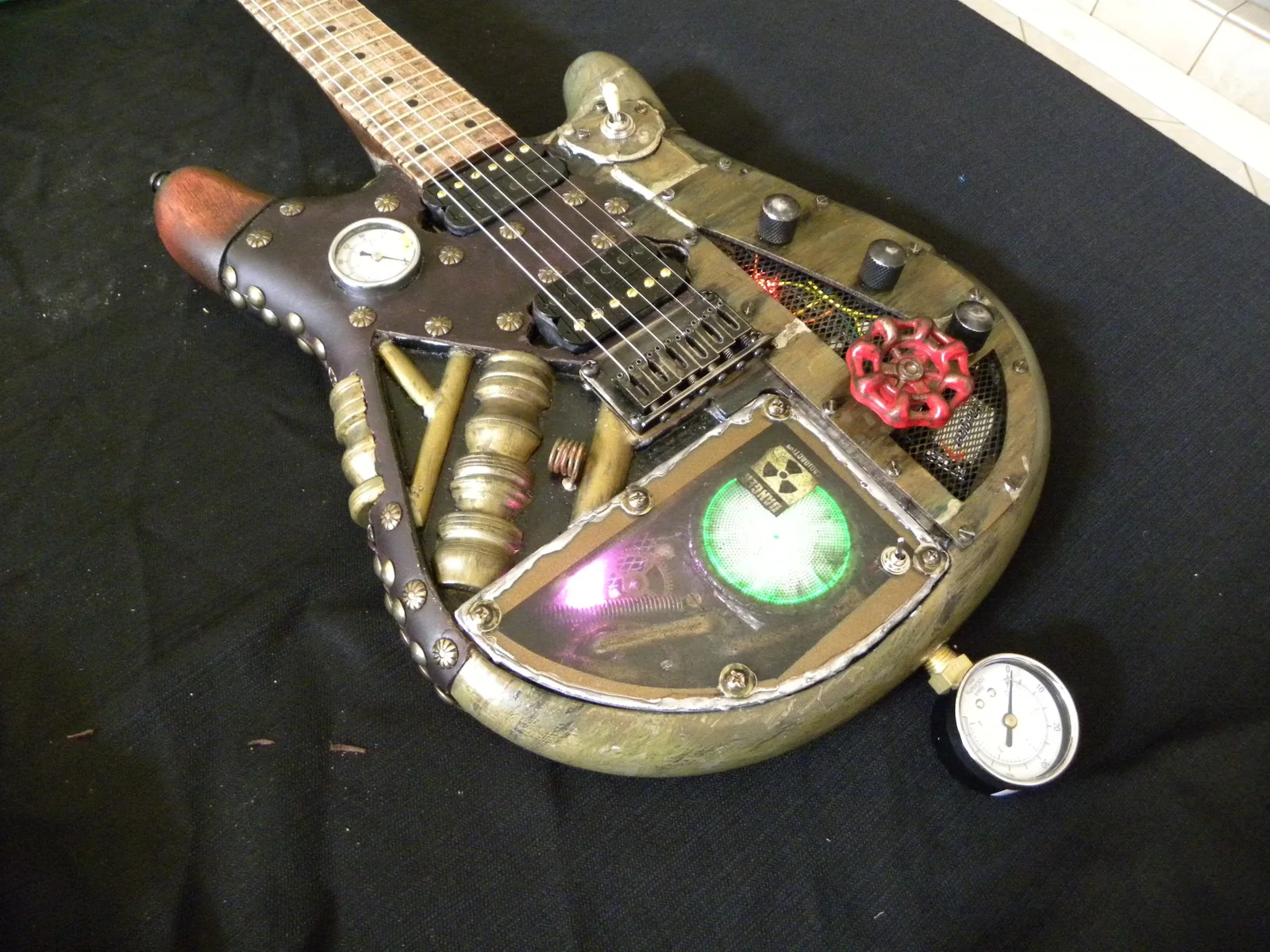
A good example of what custom meant
It was not a normal guitar wearing a costume.
I built the pipes from wood to avoid the weight and electrical problems of metal, mixed mahogany and alder to balance the electronics, hid a lighting system inside it, and used the red faucet valve to control my six-option VIP pickup system.
Rayko also owned a Model 2359 that I finished with fabric from an actual kimono.
See both Rayko Dig buildsI was never trying to mass-produce as many guitars as possible for the sake of money. Every guitar was supposed to be better than the last one. It was about making something personal, expressive, and different, and giving the middle finger to the status quo.
The hardest builds were usually the ones where I had to match something perfectly. Replicating grain, dents, scratches, wear, and manufacturing errors can take more time than building something new. At that point you are not really building a guitar. You are sculpting a counterfeit object for the sake of preserving its perceived value.
Trying to replicate Eddie Van Halen's guitar taught me more than almost any other build. It forced me to separate what mattered from what did not. It also helped me understand that people often chase the object when what they really want is the result they associate with it.
That lesson showed up again and again with customers. Most people were incredibly happy with their instruments, but some were disappointed because they expected the guitar to turn them into a guitar god. It cannot. Tone is in the hands, not in cellulose and lignin.
What made the work different
I was not interested in chasing whatever guitar people were calling the holy grail that month. The best guitar is the one that becomes an expression of your artwork and passion. If you do it right, you should not want to sell it.
There were many guitars I hated handing over after they were finished. It felt like letting a child go out into the world and trusting that it would be fine.
I also learned what I did not miss. Custom work brings constant drama. People make impulse purchases with rent money and then file chargebacks. People ask builders to create things that defy physics. Both happen more often than anyone entering the business would believe.
What happened to the company
I am not going to pretend the story has a tidy ending, because it does not. Multiple sclerosis affected my vision and motor function. Work that used to be easy became frustrating. There were days in the shop when I knew exactly what I wanted to do, but my hands would not cooperate. There were moments when I nearly broke down because I could still see the result in my head and could no longer reliably make my body produce it.
The company wound down with my health. There were guitars on the bench I could not finish and people who deserved better than a disease that did not care about anyone's plans. That is the honest version. I am not proud of how it ended, but I am not going to rewrite it into something prettier either.
What I miss most is purpose. Being creative. Making things people had dreamed about. Being appreciated for the art and the teaching.
MS has taken some things from me, but it has not taken everything. I can still teach. I can still explain. I can still pass on the art and the skills, even if that seems to be exactly what it is trying to take too.
Why this site exists
This site is part archive and part workshop. It preserves what Gelvin Guitars and my original YouTube channel, WillsEasyGuitar, were, but it is also where I put everything I learned along the way: build guides, working tools, and a full guitar building course built around the videos on my YouTube channel.
Everything is free because I do not need to nickel and dime everyone. I do not mind teaching people and helping them on their path to success. Information not shared is information wasted.
I enjoy teaching most when the person actually wants to learn. Passing on knowledge is like passing on DNA to the next generation. We all stand on the shoulders of giants, and I know I have footprints on the top of my shirt.
The goal of this site is not to make you dependent on me. It is to make you more independent. I want you to understand enough to test ideas yourself, solve problems yourself, and know when someone is selling you nonsense.
You do not need to trust me
You do not need to trust me because I say I am an expert. Look at what I am presenting. Test it. Fact-check it. Decide whether it holds up.
I am not selling you a magical part, a hidden secret, or a belief system. Everything I put on this site can be examined, challenged, and tested. I have no reason to steer anyone wrong. In fact, I am usually the person arguing for the underdog, the unpopular conclusion, or the answer nobody wants to hear.
I tell the truth as I understand it. Some people love me for it and some people hate me for it. I can live with that ratio.
What I want you to take from this
If someone learned only one thing from this website, I would want it to be this: you can do it.
Most things are easier than they look once you learn to see them differently. People let fear control their destiny. They are afraid of failure, embarrassment, criticism, or shame, and the result is inaction and self-hatred. I refuse to let fear control my life.
I did it. That is the accomplishment I am proudest of. People will always tell you that you cannot. Their fear does not have to become your future.
My goal has always been to help people become more capable, more independent, and less afraid of the things they do not yet understand.
What this site is
Gelvin Guitars is now a one-person site about playing guitar better and building electric guitars from scratch. Everything on it is free to use. There is no sign-up wall, no email gate, no paid tier, and nothing crippled to sell you an upgrade. The tools are built to be opened, used, and closed.
How it is paid for
The site is primarily supported by advertising. There are ad slots on most pages, placed between sections rather than inside the tools, and none of the kind that follow you down the page or cover the content on a phone. If an ad ever gets in the way of using something, that is a bug. Tell me and I will move it. Visitors can also leave an optional tip, but every tool, lesson, and course stays free whether they do or not.
Your privacy, briefly
The tuner uses your microphone entirely inside your browser. Nothing is recorded or uploaded. The same goes for the other browser-based tools here: they run on your device, not on a server. The privacy policy has the full detail, including what the ad network does, which is the only part not under my control.
Corrections
Guitar writing is full of confidently repeated nonsense, and some of it may have made it in here. If you find something wrong, a fingering that does not work, a measurement that is off, or a claim that does not hold up, send it over. I would rather correct the page than defend an error.